Basketball season is starting. When sports seasons change I take the opportunity to put fresh eyes onto my workshops.
When working with both sports and business teams, I used to start with goals. They are, after all, the workhorse of mental performance skills. I recently took a class at the University of Montana and was reminded of Dr. Jack Lesyk’s pyramid.
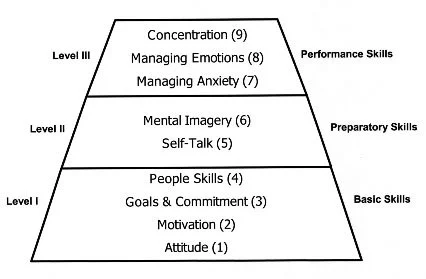
Notice how goals and commitment are a basic skill, but they are not the first one. Furthermore, Lesyk was later asked where confidence fits into his basic skills. His response was, “"Basic skills are the files and confidence is the folder."
So, this year, I’m going to reorder my workshops to start with Confidence.
Confidence And Self-Efficacy
Lesyk does not go into confidence very deeply because he believes it is emergent from the other basic skills, but I heard a podcast, I think it was Finding Mastery, in which Bandura’s Self-Efficacy Theory was used as a framework for confidence and it made a lot of sense to me. If you want to read more about Bandura, Simply Psychology has a great article on his theory [https://www.simplypsychology.org/self-efficacy.html].
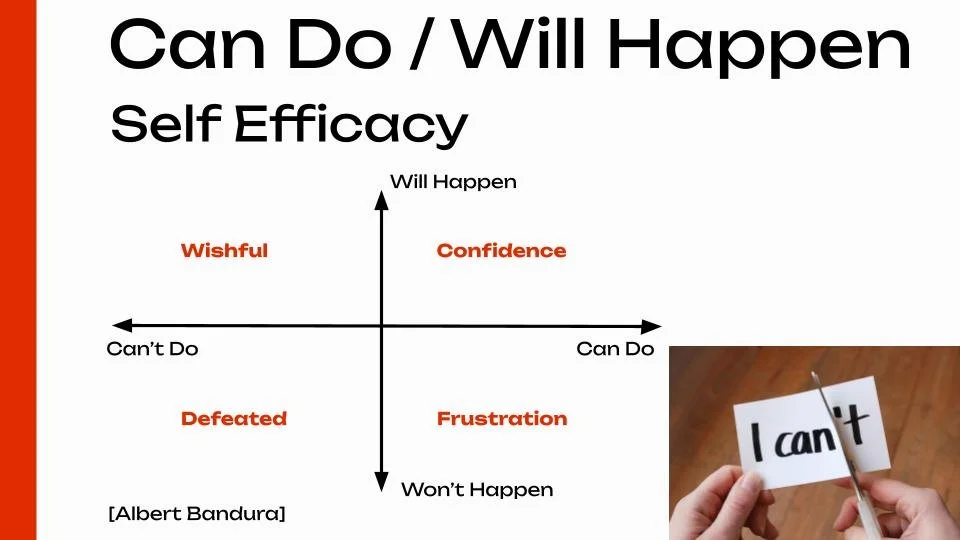
Self efficacy is a strong belief that you can successfully complete an action that will lead to your desired goal. That also sounds a lot like confidence to me. Put another way, it is the belief that you CAN DO something and, if you do, the desired outcome WILL HAPPEN.
This is a slide from my workshop.
The Free Throw Line Example
Let's look at a player standing at the free-throw line with the game tied.
Defeated (No Can Do / No Will Happen): This player knows they haven't practiced their shot (No Can Do) and is already thinking, "There is no way this is going in" (No Will Happen). They are mentally beaten before they even touch the ball.
Wishful (No Can Do / Yes Will Happen): This player skips practice and has messy shooting mechanics (No Can Do), but irrationally believes, "I'm clutch, so this is going in" (Yes Will Happen). This isn't confidence; it's delusion or luck.
Frustrated (Yes Can Do / No Will Happen): This player has perfect form in practice and makes 50 in a row (Yes Can Do). But in a game, they think, "The crowd is too loud," or "I always choke." They have the skill, but they don't believe the result will follow. This leads to massive frustration and hesitation.
Confident (Yes Can Do / Yes Will Happen): This player has put in the reps and owns their mechanics (Yes Can Do). They step to the line believing, "If I just execute my routine, this ball finds the net" (Yes Will Happen). That alignment of preparation and belief is true confidence.
Can Do
Can Do is the process component of confidence. How do you build the ability to complete a certain process? First you need to learn the skill and learn it well. That might take study or coaching. Then you need to practice the skill to integrate it into your mind and body. Once you know you can do something, then the next step is learning to believe that you can maintain the skill in a game, match, meeting, etc. That’s where imagery comes in. If you’ve read my blog before, you know that the mind cannot distinguish between an actual event and a well-imagined one. With imagery training, you can get rep after rep of successfully completing an action in whatever situation you need without leaving your house. That takes care of Can Do.
Will Happen
Can Do is the process, Will Happen is the outcome. You need to learn to believe that IF you can exhibit your skill, then your desired outcome will happen. This requires mental discipline. I don’t mean self-scolding. I mean having the discipline to vividly remember past successes, even if they were in practice situations or done by someone else, as demonstrations of the truth and to filter out any past failures. Remember, a growth mindset is knowing that you are always either winning or learning. When there is a learning opportunity, then you must learn from it. Then keep the lesson and forget the event. You can rationalize away any undesirable outcome that arose from a desirable action and then forget it in the name of curating your memories. The goal here isn't to be unaccountable or delusional. The goal is to protect your Will Happen belief. Nate Zinsser refers to this as building a mental bank account of positive memories. If you miss a shot, you analyze the mechanics later in practice. But in the heat of the game, you attribute the miss to an unlucky bounce so that you don't hesitate on the next shot. You are protecting your conviction that if you execute, it will happen.
Ultimately, building confidence is an active process, not a passive hope. By mastering your preparation and mental imagery, you solidify your 'Can Do' belief. By disciplining your mind to focus on successes and constructively filter setbacks, you strengthen your 'Will Happen' conviction. If you’ve got both of these, you are living in the upper right quadrant of confidence. Ask yourself: are you wishful, frustrated, or truly confident? Identify where your belief is breaking down, and start doing the mental work today to move yourself into the upper right corner where peak performance lives.